Why classical myth and autism?

Why classical myth and autism?

The idea for this project started to take shape at a meeting in 2008 with a special needs teacher, who mentioned that, in her experience and those of her colleagues, autistic children often enjoy classical myth. I began to wonder why this might be the case, and whether – as a classicist who researches, and loves, classical myth – there was anything I could contribute. I started this blog to report on my progress which was often sporadic until the launch of the Warsaw-based European Research Council-funded project Our Mythical Childhood (2016-22) to trace the role of classics in children’s culture.

My key contribution to the project is an exploration of classics in autistic children’s culture, above all by producing myth-themed activities for autistic children. This blog shares my progress, often along Herculean paths, including to a book of lessons for autistic children focusing on the Choice of Hercules between two very different paths in life. The image above, illustrating the homepage of this blog, is one of the drawings by Steve K. Simons, the book's illustrator, of a chimneypiece panel in a neoclassical villa at Roehampton in South West London. The lessons centre on this panel.

Thursday, 21 November 2013

Classical Studies and Disability Studies


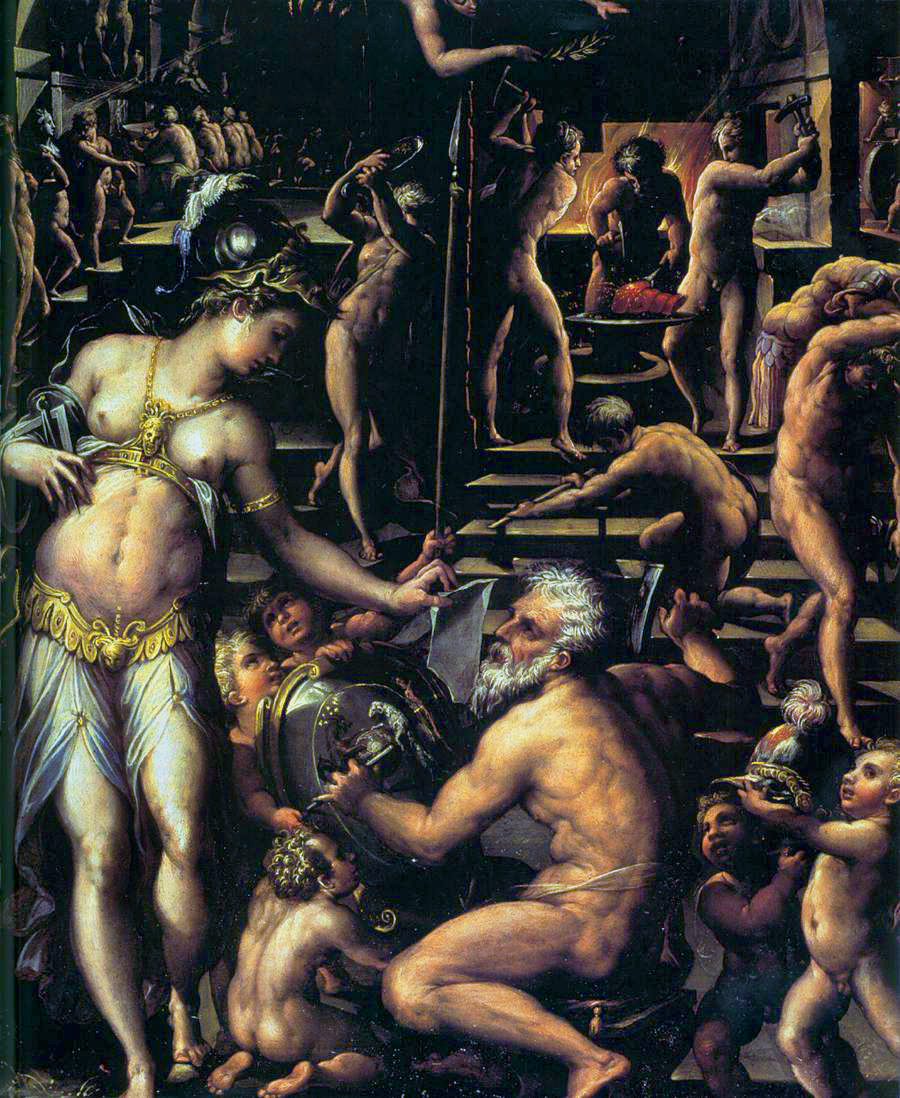
Hephaistos visited by Athena or Thetis
This posting responds to two recent experiences.  The first of these was writing, publishing and then getting some really interesting feedback on my previous blog post, where I expressed my intention to consider how far a disability studies approach to heroes and monsters of classical myth might aid the development of monstrous pedagogies.  The second was contributing a session, 'Classics and Disability Studies', to an MRes 'Theories and Methods' module at Roehampton yesterday evening.  The students were deeply engaged - so much so that the session took on a 'life' of its own that diverged from the notes I had prepared in advance.  Here are those notes, written up but also expanded. 

We began by considering examples of disabled persons from antiquity. I anticipated that the 'obvious' ones would be named such as the doubly-disabled Oedipus (lame from birth and later blind), the lame god Hephaistos, and the Spartan newborns who fell victim to the Spartan programme of eugenics.  These were indeed named, as were others with physical disabilities, including the emperor Claudius, the Homeric non-hero Thersites and the blind prophet Teiresias.  But the students also asked about how to define 'disability' - did it mean physical disability, or could it include, say, mental ill-heath or dyslexia? What about figures who were not regarded as disabled in antiquity but whom we might define as such now: Achilles, being one such example - perfectly bodied, but in the wake of Jonathan Shay's analysis, one of a host of heroes showing traits of Post Traumatic Stress Disorder? We also considered how far disability needs to be seen as something that dis-abled an individual.  For instance:
  • When the Amazons are said to remove one of their breasts are they thought of as disabling themselves or, rather, enabling themselves to perform their roles more successfully? 
  • What about when a disabled individual has different abilities that are developed precisely because he or she is disabled, Hephaistos being a case in point. As I mentioned, on the Parthenon frieze, the god with the most developed musculature is Hephaistos - one way of reading this representation of the god is that, through his physical labour, he meets standards of bodily perfection in ways denied his fellow gods; it is a marker of his difference from the other major gods - in ways I'll build on below.
Issues therefore include these:
  1. How far should a disability studies approach focus on aspects of physical disability?
  2. How far can research into conditions such as ADHD, Bi-polar disorder, PTSD, autism and dyslexia offer fresh interpretations of mythological, and other, figures. For instance, can one offer a reading of the Olympian gods through the prism of autism to look from a fresh angle on the special interests pursued by each of them?
What is disability studies? 

Among the various models are the following two:
  • Firstly, and now outmoded: the medical model, whereby a disability is a disorder that affects a particular individual.
  • Secondly, the social model, according to which disability is a social construction. This comes with a major shift in thinking - away from the 'medical model' that holds that individuals are disabled, and as such need to make adjustments to fit in with society, and towards a notion that it is actually society that does the disabling.
So it is not that disabled people need to change, but that society needs to change in order to make provision for disabled persons.  This has come with a change in terminology away from 'people with disabilities' to 'disabled persons'. For example, rather than talking of a 'person with dyslexia', instead one might talk of a 'dyslexic person'.  So - from being viewed as an individual, pathological disorder, disability can be regarded as a social construction, and with this there has come to be a recognition that the experience of disability will differ between persons, even those labelled similarly, e.g. as dyslexic or autistic. 
 
A consequence of this turn to a constructivist approach to disability has been that, to understand more deeply how disability is socially constructed, a place can be found for the study of disability across disciplines, including anthropology, literature, art, and history.  From the perspective of history, there is the potential to explore how disability was regarded in different periods, including in antiquity.  The potential for classics to contribute here is huge, when for example disability is 'good to think with' in myth, perceptions of tyranny etc - as I shall outline later.
 
One of the major studies to date is that of Rose's Staff of Oedipus of a decade ago which looks for what disability meant in the ancient Greek world, and what the experiences were of disabledpersons.  Rose situates her work in relation to the project of historicising disability. Her findings include:
  1. that there must have been a range of body types beyond the sculptural ideal, including from war injuries
  2. that the practice of killing deformed babies was less widespread than previously thought
  3. that Hephaistos provides a useful example of a different kind of body
  4. that the split that we today perceive between disabled and non-disabled people was not present in ancient Greece - shown, for instance, by the range of roles open to disabled people
  5. that our views cannot be mapped onto the past: our categories were not used to classify people
  6. that ancient Greece was forward looking: disability was not used to mark difference.
There is a fit with the argument of Fiedler  that we are anachronistic if we assume a consistent way of seeing disabled bodies in antiquity and today. According to Fiedler, the discussion of disability in antiquity has been anachronistic in assuming that  ‘the strangely formed body has represented absolute Otherness in all times and places since human history began’ (1996: xiii). 

Dolmage, meanwhile, looks for different kinds of bodies in antiquity: at least in myth, such as:
  • The monstrous body of Medusa
  • The lost body of Metis
  • The disabled body of Hephaistos
On the ‘import of bias’ onto ancient thinking about disability, v. Dolmage 2006; Dolmage 2009: 6-7.
 
Such an approach is readily possible as seen by two diverging ways of approach Hephaistos, for example, firstly that he was inferior to Athena (because her birth honoured her father while that of Hephaistos dishonoured his mother) and secondly that his birth rendered him klutos ('glorious'). I'll quote from my forthcoming book on Athena as 'traitor' and 'trickster':
       In the Homeric Hymn to Apollo, Hera’s fury is vented at Zeus for his successful attempt to ‘dishonour’ her (3.312) with the birth of ‘glaukopis Athena who is foremost among all the blessed gods’ (314-5) while ‘my son Hephaistos, to whom I gave birth, was shrivelled in foot and a shame to me’.  This god, according to his mother is, moreover, ‘weakly among the blessed gods’ (316-7). However, the Hephaistos presented in the Theogony of Hesiod is not an inferior being but a god who, as ‘glorious’ klutos (927), stands unequalled among the gods in the expertise that makes him ‘more skilled in techne than all the descendents of Ouranos’.
An aside: why isn't Athena disabled but the exemplar of hygieia, (good health, whence our 'hygiene'), which as I'll consider presently could be opposed to 'disability'?
 
There is, however, a source which does point to a classification more akin to ours: Lysias 24: On the refusal of a pension to the invalid.  The speaker has been accused of illegally drawing the pension granted to hoi adunatoi, a phrase which is generally translated 'the disabled'.  The pension was, according to the Ath. Pol., granted to those who were in poverty, and 'incapacitated by a bodily infirmity' (Constitution of the Athenians 49.4 check tr.!).  A contrast is drawn being hygiainos ('in good health') and adunatos ('disabled': Lys. 24.13); such persons should be regarded, according to Lysias, as deserving of pity.
 
Moreover, various sources for archaic tyrants and colonists fit the 'medical' model rather than the more constructivist social model underscoring Rose's work.  In the words of Ogden's title and cover-image they are 'crooked' literally and metaphorically.  Battus, the founder of Cyrene, was cured of his stammer when he shouted at a lion in the countryside outside the Cyrene who then fled.  See here, Gurentch's article.  Labda, the mother of Cypselus the tyrant of Corinth, was named as such, supposedly, after the capital letter lambda, because her feet turned outwards.  She was a member of the ruling Bacchiad clan, but, because of her deformity, was - exceptionally - married outside the clan; the child of her marriage, at once of Bacchiad descent and an outsider, usurps power.
 
Aside: it's worth thinking about how tyrants are exceptional individuals, both greater and lesser than ordinary mortals, and disability is one of the aspects that marks them as such.
 
Some prelimary conclusions:

There are two potential benefits to studying disability in antiquity, or to studying antiquity through the prism of disability:
  1. To shed fresh light upon the classical world
  2. To add to work in Disability Studies on how to historicise disability.
Also:
  • The thesis of Rose cannot be upheld insofar as there were provisions or disabled people as a category as well as a sense of the disabled body as a different one, whether inferior or superior.  The medical model can be applied more readily than the social one. Where physical disability is concerned, one can draw the same kind of conclusion as for so many groups in ancient Greek life (e.g. slaves, rape victims): that the ancient world was not a nice place. 
  • But the social model can be applied as follows: The study of disability in ancient Greece does not need to focus solely on the experiences of specific disabled persons.  Also of interest is how disability was constructed to reflect on such issues as health, skill (and so 'ability'), difference and status. 
  • And also of interest - and as touched on in this posting - is how far the ancient Greek world can be read in relation to work on disability, e.g. autism, PTSD and learning differences.

Some links and references (not yet standardised...)
  • For work largely in German but also with plenty of references to work in English: http://www.disabilitystudies.de/literatur.html
  • The Leeds Centre of Disability Studies includes lots of reading material: http://disability-studies.leeds.ac.uk/
  • Rose's work arguing for Greece as “forward-thinking“ in terms of disability, and not using disability as a marker of difference: Martha L. Rose. The Staff of Oedipus. Transforming Disability in Ancient Greece. Ann Arbor: The University of Michigan Press, 2003.  See the review in a Disability Studies journal at: http://www.dsq-sds.org/article/view/875/1050
  • Fiedler, L. 1996. ‘Foreword’, in R.G. Thomson ed. Freakery: Cultural spectacles of the extraordinary body. New York: New York University Press: i-xv.
  • Dolmage, J. 2006. ‘Breathe upon us an even flame: Hephaestus, history, and the body of rhetoric’. Rhetoric Review 25.2: 119-40.
  • Dolmage, J. 2009. ‘Metis, mĂȘtis, mestiza, Medusa: rhetorical bodies across rhetorical traditions’. Rhetoric Review 28.1: 1-28.
  • Ogden, D. The Crooked Kings of Ancient Greece, London: Duckworth 1997.
  • Gurentch, Z. “The tongue´s breakdance: theory, poetry and the critical body, available“ at: http://danm.ucsc.edu/~abtollef/Physical_Poetry/toungue%20body.pdf


Friday, 8 November 2013

Monstrous pedagogies: why every Jack needs a Giant


I have started with an image that illustrates how difficult it can be to separate heroes from their monsters, or to separate monsters from their heroes. It is from a chimney-piece in one of the 18th-century Adam-esque rooms in Grove House, now part of the University of Roehampton: my workplace. I've homed in on it as a vehicle to set out my initial thoughts in response to a Call for Papers that a colleague sent me earlier this week, and which might be the prompt that, after several years, takes this blog and the project on which it reflects, to a new level. The Call is for the 2014 Higher Education Academy Arts and Humanities conference, which this time round will be on a quest for 'monstrous' pedagogies as expressed via the event's title - 'Heroes and Monsters: extra-ordinary tales of teaching and learning in the arts and humanities'.  The particulars make clear that the event is looking for ways to challenge current ways of learning and teaching to 'make strange' academic practice and challenge what is taken for granted by its practitioners.  On the conference's definition, monsters dwell in realms just beyond our own; they can come into our world to 'unnerve' us and 'innervate' us, and thus a 'monstrous pedagogy' can 'disrupt habits' and 'articulate...different ways of being'.  But who are 'we'? 

There is a suggestion running through the particulars that 'we' are the heroes, while it is the monsters who come into 'our' world to shake it up.  The sense from the particulars is that this is a good thing and that the goal of the event can be to make room for this otherness to improve the experience of all, heroes and monsters alike. This is expressed most of all in the explanation of one strand of the conference, 'Slayers, Scoobies and Watchers', which, noting that 'every Giant needs its Jack', 'celebrates the heroes who hold the line at the hellmouth by sharing tales of epic battles and vanquished learning and teaching demons'.

But who are the monsters?  What about the learner or teacher who is not trying to find space for otherness, but who is already different... other... a monster...   Can a monster create a monstrous pedagogy, or does such a pedagogy get created for a monster, or even to vanquish a monster? For a initial illustration of what I am trying to get across, I'll mention two sets of articles that were published several years ago in CUCD Bulletin.  Firstly, in the 2009 volume, two papers sought ways to deal with the challenges encountered by dyslexic students on ancient language modules - including by seeking ways to understand how a dyslexic student might see the world.  Secondly, on reading these articles, Ray Laurence, 'dyslexic and...also a classicist' (Laurence 2010: 6), was prompted to write a piece for the 2010 Bulletin which challenges the perception of a dyslexic way of perceiving the world as one beset with problems.  In  place of the 'deficit model' of dyslexia, he advocates a focus upon the distinctive abilities that are characteristic of dyslexic people not least in visual and holistic thinking.  As Laurence makes clear, he is hardly saying something new when as long ago as 1996, the Tomlinson Report on Inclusive Learning was setting out the need for an inclusive curriculum that meets the needs of all students.

I have to break off now to prepare for a meeting - when I can get back to this, I will go on to discuss:
  • how the angle that the HEA has selected for this conference dovetails with my autism/classical myth project;
  • the potential of a 'disability studies' approach to disrupt the habits of academics;
  • how the hero/monster metaphor can inform the quest for disruptive pedagogies;
  • how the specific image of heroic monstrosity with which I started this posting can bear on the quest for such a pedagogy;
  • how a heroic pedagogy can be a monstrous one;
  • why it's still 'all Greek to me' to quote from an earlier posting title;
  • how what I'm thinking through here builds on other work I've done and will be doing on building an inclusive curriculum, on teaching 'sensitive subjects' and on who 'owns' classical myth.


Thursday, 21 March 2013

Inclusivity and Diversity in UK Classics Programmes


I've started this posting with an image that I've just chosen for a poster I'm currently putting together.  It's to advertise a workshop that I'm co-organising at Roehampton for this coming May.  The event will explore issues surrounding the creation of an inclusive and diverse classical curriculum and as one of our planned themes is disability, an image that conveys a Hephaistos one could read as variously marginalised or powerful seems fitting.  Here are draft details of the event:

Roehampton University, London, Thursday 23 May 2013 11.30am-3.30pm

This HEA-funded workshop aims to explore the extent to which UK Classics departments can improve on inclusivity and diversity in their student bodies. The idea for the workshop was generated out of work being done at the University of Roehampton in an HEA funded project on ‘Re-imagining Attainment for All’ which is investigating what factors enhance the success of and what elements are barriers to the success of for BME students. The workshop will also build on previous work at Roehampton into making learning happen for disabled students studying classical civilisation.

Topics to be covered include:

• What is the perception of Classics and related degree programmes such as Ancient History and Classical Civilisation among prospective students?

• Do some students feel excluded from studying Classical subjects?

• Why do so few students from particular black and minority ethnic groups apply to study Classical subjects?

• What support is there/should there be for disabled students, e.g autistic and dyslexic students?

• How can the degrees/curriculum be made attractive to a diverse range of students?
For further information, please contact Susan Deacy (s.deacy@roehampton.ac.uk) or Fiona McHardy (f.mchardy@roehampton.ac.uk)

Tuesday, 19 June 2012

Classics in therapy

I've started with this image of the Hyde Park Wellesley (as?) Achilleus moument for two key reasons.  Firstly, I'm currently exploring the extent to which 'our' reception of classical culture has been shaped by the sculpture that tranformed civic, and also private, architecture in the 18th and 19th centuries, not least in London.  Secondly, it seems an apt illustration connected to a development which was reported on at an event I attended last month on Classical reception teaching.  Prof. Lorna Hardwick surveyed the range of developments in classical reception around the world, including at the US, where one area of increasing interest is the therapeutic role of classics, including the work with with war veterans pioneered by Jonathan Shay's Achilles in Vietman.  I'll find out who is working in this area - in the meantime, I'd welcome suggestions as to whom to contact!


I'll report soon concerning other recent experiences that bear on this blog.  I anticipate that this will include reflections upon how the mythological topics we choose to study are ones that 'speak' to our lives in complex ways - more that we might realise.  Linked with this, I've been discussing with colleagues how far they way we respond to myth can have useful therapeutic potential, from childhood experiences discovering the stories onwards.  One speaker at an event on classical mythology at the Open University earlier this year spoke about how one woman's engagement with the Demeter-Persephone story helped her deal with her experiences at a time when her daughter was leaving home.  There is one thing that concerns me, namely that this kind of engagement could be risky: the distance between ourselves and the material is broken, but there is no therapist to support us - unless we are in the safe space of, say, a dramatherapy session.

Wednesday, 1 February 2012

Disability Studies and different bodies in antiquity

File:Atena e hefaisto.jpgSince beginning my blog, I have become increasingly aware of how the growing field of Disability Studies has the potential to impact both upon my myth and autism project, and upon my research into other aspects of classical mythology.  I'm especially interested currently in its potential to offer fresh insights into a pair of deities frequently connected with one another (in e.g. Hesiod's Theogony and in Athenian cult/art/literature: witness for example their representition side-by-side on the Parthenon frieze).  The deities in question are the disabled god, Hephaistos, and his technological and sexual partner, Athena.  The visual depiction that I have chosen to illustrate this posting is Giorgio Vasari's Vulcan's Forge which represents Athena as - I think - out of place in, if not superior to, the world of the smithy over which the god precides.  I'm interested in why this aspect of their relationship should have been emphasised in the sixteenth century and how far it has a counterpart in ancient representations of the relationship between the gods.


The value of examining Hephaistos from a Disability Studies perspective is easy to convey - he is the god who was either born lame, or who became lame after he fell from Olympos, when he was thrown off the mountain after he was born by his mother, Hera.  Here incidentally, we encounter one of those chicken-or-egg instances of Greek myth: his mother detested him because he was lame, or he became lame after his mother threw him off the mountain.  Athena's relevance to this approach is harder to convey initially - she is, after all, a goddess celebrated for her bodily perfection, and her roles included the patronage of hygieia, that is, good health, a quality that can be contrasted with adunatos ('disability').


I aim to look at various aspects through the lens of Disability Studies, including:


1. Why Hephaistos, born as a result of the contest between Zeus and Hera to produce a parthenogenic child, is born disabled, when Zeus' child, Athena is bodily 'perfect'?


2. The connection between Athena's body and the lost body of her mother, Metis (aka Outis: 'Nobody'), who is swallowed by Zeus when she is about to give birth.


3. The connection between the body of Athena and the monstrous body of Medusa, whose head she wears on her aegis.  Why does Athena react with horror when she catches sight of herself playing the aulos and sees her puffed-out and gorgon-like cheeks?


A key question to ask when conducing this study will be one that is engaging specialists in Disability Studies, namely: are attitudes towards disabled persons cross cultural (or even rooted in evolution) or are the Greeks' views of disability a condition of their own particular cultural contexts.  It is possible to steer between these two positions.  One consequence of the 'social model' of disability studies (refs. to follow!) has been that, to understand more deeply how disability is socially constructed, there is scope for multi-disciplinary study from specialists in areas including anthropology, literature, art and history.  From history, classical history included, we can enrich our understanding of how disability was regarded in different periods.  I therefore see the potential to do two key things:


1. Find ways to shed fresh light upon the classical world
2. Add to work being done to historicise disability


I shall build on this post in due course including by supplying references to key works in Disability Studies as applied to the Greek world.

Wednesday, 23 March 2011

Autism, Asperger Syndrome, Perseus and Athena


Inspired by emails that I've received just this week from two separate teachers working with autistic children, I have been revisiting an an article I wrote for the 2009 Bulletin of the Council of University Classics Departments setting out what I then saw as the rationale fuelling my work.
 
The remainder of this posting will take the form of a very slightly updated version of that article not least as the journal is temporarily unavailable in its electronic format.  Once it becomes available electronically again, I shall give details of the url.  I also plan, in a subsequent posting, to discuss the image that I have chosen to head this posting: The Baleful Head that Perseus, as represented by Burne-Jones, sees yet fails to become subsumed by.

I began with some general comments on Asperger Syndrome, the autistic spectrum condition on which I was then envisaging focusing.  I am now thinking that a more 'general' autistic focus would be preferable, a development on which I shall report soon.  Anyway, I made these comments with a caveat that they were generalised comments that reflected how little is yet known about the condition in spite of progress in understanding, diagnosis and treatment over recent years (see Frith, 2003; Frith, 2008). Asperger Syndrome is, I stated, an autistic spectrum condition, more commonly diagnosed in males than females, which can result in often subtle differences in aspects of social behaviour, communication and application of mental flexibility (e.g. Brown and Miller, 2004; Martin, 2008). Each person with Asperger Syndrome will have particular needs and challenges. People with Asperger Syndrome may have particular strengths, which can be harnessed when they are given the right support, which include attention to detail, a methodical approach, accuracy, reliability and good motivation.

I noted in the article that I tried out my initial hypothesis—that classical mythology might provide a fresh means of supporting people with Asperger Syndrome—on several colleagues, all of whom thought the topic worth pursuing, not least one who, I discovered, had worked previously in therapy and suggested that I approach dramatherapists as potential research partners. Subsequent contacts with current practitioners had encouraged me further that classical mythology’s potential therapeutic uses would be worth exploring, as has my preliminary reading on dramatherapy.  I reported that when I started reading Jones 2005, I anticipated that I would be solely lapping up new knowledge, but I also found myself thinking from a fresh perspective about material that I had been teaching for several years. I discovered that the approach taken to drama in dramatherapy, not least the application of the Aristotelian model of catharsis, intersects with one of the approaches currently being advocated in classics to the mythmaking of ancient drama which, as Buxton stresses in his chapter in Woodard ed. (Woodard, 2007: 166–89), characteristically selected material that drew upon the underside of myth. Tragedy created a mythic environment that explored what was troubling, problematic and antisocial between the individual and society, as well as between family members such as siblings of the same or opposite genders, mothers and daughters, mothers and sons, fathers and sons or fathers and daughters. Ancient drama goes to the heart of dramatherapy as it is described by Jones as ‘forming the meeting point between psychology and drama’ (2005: 41).


To give some indication of ancient myth’s possible value for dramatherapy, I started with a visual image (Attic red-figure cup from Cervetri by Douris; Rome, Vatican 16545) that has been regularly used an illustration in volumes on mythology, due largely, I would surmise, to its combination of popular goddess and well-known story. By depicting Athena as the patron of heroes, assisting Jason on his quest for the Golden Fleece which is hanging on the tree behind him, not only does it show Athena in one of her most prevalent guises, but it includes a good range of her attributes too, including the owl which is shown only on relatively few vases. There is much scope for interpretation, for example of how the aegis’ scales match those of the monster in a way that might suggest a ‘dark side’ of Athena, something that Klimt seems to intimate in his Pallas Athena, where the scales of the aegis match those of the Triton in the vase painting in the background
The artist, Douris, has picked a key moment from the iceberg of material at ancient mythmakers’ disposal and packed it into unities of time and place. But precisely what that moment is on the vase is unclear, which took me to another reason why I picked this particular example. It draws attention also to how much remains unknown in spite of the wealth of evidence for classical myth. The mystery for us—not the intended audience, at least I assume not—is in what is happening between Jason and the monster, who seems to be regurgitating him or to be in the process of swallowing him, a detail omitted from the literary versions. There is more as well: Athena’s assistance-giving is at odds with the literary accounts that we possess (e.g. Mimnermus fr. 11a; Apollonius Rhodius, Argonautica 3) where it is Medea who serves as the helper-maiden of Jason, when she assists him in yoking the bulls, sowing the dragon’s teeth and then putting the dragon to sleep while he takes down the fleece.

The image illustrates myth’s mixture of familiarity combined with an otherness that keeps it frustrating with its stories that we know and yet often never really know. Neither did the ancients, however, have some canonical version of a myth as recent work on the topic is stress-ing (e.g. Morales, 2007; Woodard, 2007). What I anticipate being able to bring to dramatherapy is an engagement with this duality of mythology: between the reassurance it provides of a familiar story, combined with possibilities for creativity. I am planning, as one of my initial investigations, an exploration of what might be done with the ‘gaps’ of classical myth in the light of some of the fundamental goals of dramatherapy as Jones introduces them: ‘to free the imagination and to increase spontaneity’ (2005: 4).

One of the things that attracted me to classical studies as an undergraduate student was its interdisciplinarity, although I doubt I knew that term then. Back in 2009, I made the point that I had never really stepped outside the confines of the discipline, broad though these boundaries are. Where I had thought ‘big’, through applying gender theory for example, or comparative anthropology, it had been with a view to enhancing classical research. Now I have an opportunity to be able to think about how research into classical mythology might have an impact beyond the humanities. I anticipate that guiding my further forays into dramatherapy and mythology will be the potential of the doubleness of mythology to reach people with Asperger Syndrome. I felt able to contend at this early stage that classical mythology has the capacity to take someone with Asperger Syndrome into a world that is separate from daily life while allowing engagement with the challenges encountered in everyday life. I was, and still am, at too early a stage in my investigations to make any conclusion other than to say that the therapeutic potential of classical mythology appears to be considerable.

Works cited
  • Brown, M. and Miller, A. (2004) Aspects of Asperger’s: success in the teens and twenties, Bristol: Lucky Duck Publishing.
  • Frith, U. (2003) Autism: explaining the enigma, 2nd edn, Malden, Mass. and Oxford: Blackwell.
  • Frith, U. (2008) Autism: a very short introduction, Oxford: OUP.
  • Jones, P. (2005)The Arts Therapies: a revolution in healthcare, Hove and New York: Brunner-Routledge.
  • Martin, N. (2008) REAL Services to assist students who have Asperger Syndrome, Sheffield Hallam University Autism Centre, available at www.skill.org.uk/page.aspx?c=61&p=150#HE
  • Morales, H. (2007) Classical Mythology: a very short introduction, Oxford: OUP. Woodard, R.D. (ed.) (2007) The Cambridge Companion to Greek Mythology, Cambridge: CUP.

Friday, 23 July 2010

Dramatherapy

In early postings to this blog I noted that one possible area of research was into dramatherapy's potential to reach autistic people. I'm excited to note that, from tomorrow, I shall be taking the Dramatherapy Summer School at Roehampton.

In documents I produce, I've tried to go for accessible formats - e.g. using pastel colours for handouts for dyslexic students. Much though I loved the intial design of this blog with its picture of a building at the top with a classical-ish design, I've tried for something that is more accessibly formatted in terms of background and clarity.