Why classical myth and autism?

Why classical myth and autism?

The idea for this project started to take shape at a meeting in 2008 with a special needs teacher, who mentioned that, in her experience and those of her colleagues, autistic children often enjoy classical myth. I began to wonder why this might be the case, and whether – as a classicist who researches, and loves, classical myth – there was anything I could contribute. I started this blog to report on my progress which was often sporadic until the launch of the Warsaw-based European Research Council-funded project Our Mythical Childhood (2016-22) to trace the role of classics in children’s culture.

My key contribution to the project is an exploration of classics in autistic children’s culture, above all by producing myth-themed activities for autistic children. This blog shares my progress, often along Herculean paths, including to a book of lessons for autistic children focusing on the Choice of Hercules between two very different paths in life. The image above, illustrating the homepage of this blog, is one of the drawings by Steve K. Simons, the book's illustrator, of a chimneypiece panel in a neoclassical villa at Roehampton in South West London. The lessons centre on this panel.
Showing posts with label dramatherapy. Show all posts

Thursday, 30 March 2023

Autism Acceptance Week – Thursday… ‘What Isadora Duncan knew: Athena as Dance Movement Therapist in ancient Greek art’


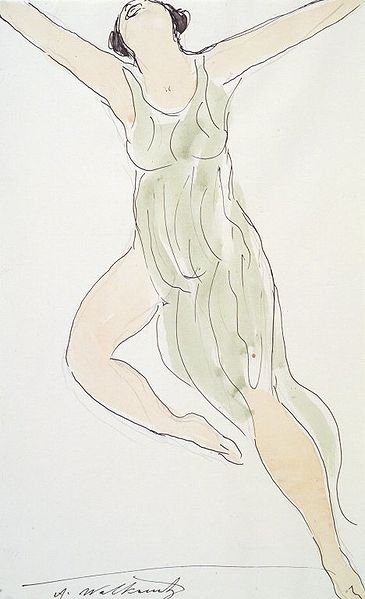
File:Brooklyn Museum - Isadora Duncan 29 - Abraham Walkowitz.jpg
Abraham Walkowitz, Isadora Duncan #29, c. 1915.
W
ater and ink over graphite, Brooklyn Museum 39.174,
retrieved from Wikimedia Commons

A formative period for me while I was very much in the formative stages of being interested in connecting autism and classical myth was when I took a week-long dramatherapy course run by the Arts Therapies team at Roehampton.

It was an experience that went differently than I had expected. I had imagined us sitting in rows making notes from sessions led by the tutor. In fact, however, to introduce us to dramatherapy, we were all immersed in it as though we were clients. It was a deeply personal, sometimes difficult and transformative time.

Then, about a year later, I signed up for another course run by the same team on autistic bodies and movement. I was excited and was feeling some anxiety too about what would happen – but what happened was that the course was cancelled. So I never got to know.

Since then, however, movement and autism has been something I have been wanting to find out more about. And already, I have seen that it is when people copy the gestures of Hercules, Pleasure and Hard Work - on the panel that is key to the autism activities I have developed so far - that they move to a deeper level of engagement.

Carter Workshop, Chimneypiece panel depicting Hercules tasked
with choosing between Pleasure and Hard Work, Adam Room, Grove House,
Roehampton. Photo by Marina Arcady

I am soon going to be writing a paper that might enable me to gain an understanding of some of what might be involved. I am going to be spending several days in Coimbra in Portugal in July, participating in the Celtic Classics Conference. The panel I’ll be part of is Religious Movement in Ancient Mediterranean Art’, convened by two inspirational ancient religion and art scholars Ellie Mackin Roberts and Tyler Jo Smith. What prompted me to offer a paper was especially one of the features in the Call for Papers which was that ritualised movement would connect participants and the deities being worshipped. Reading this, I wondered what could be brought into play – pun not intended, but I can’t think of a better way to put it… - when it is the god who is dancing.

I proposed a paper that employs Dance Movement Theory to examine the role of dace when on particular ancient deity, Athena, is being depicted or imagined as a dancer.

File:Amphora birth Athena Louvre F32.jpg

Athena emerging from the of Zeus, Attic black-figure belly amphora, c. 550-525 BCE 
belly amphora, 
now in the Louvre, Paris F 32. Retrieved from Wikimedia Commons

Here is the paper I proposed: 

What Isadora Duncan knew: Athena as Dance Movement Therapist in ancient Greek art

As noted in the Call for Papers, ritualised movement connects participants and the divinities being worshipped. But what about when it is the divinity that dances? Employing Dance/Movement Theory – where a client and a therapist engage in an empathetic process to facilitate the physical, emotional, social and cognitive integration of the individual – this paper will explore the significance of dance in relation to Athena. This is a deity whose dancing challenges prevailing assumptions about this god as a deity of ‘mind’ whose very theonym is, indeed, derived from ‘mind of god’ in Plato’s Kratylos. But, as this paper explores, there is already the ‘other name’, Pallas, derived in the same dialogue from frenzied, frantic pulsations. 
The paper will explore how Athena enacts a divine movement suggesting an instance of what Isadora Duncan knew: that ‘dance is the movement of the universe concentrated in an individual’, above all when Athena is depicted emerging from the head – the mind indeed – of another making furious, violent movements. The paper will start with images of Athena dancing herself into being. It will then turn to depictions of a frantically moving Athena at the Gigantomachy. Finally it will explore images of worshippers dancing like – or, better, as – the deity, suggesting a reconfiguration of space and time where the act of worship is creating the god, and where the god (therapist) and worshipper (client) are joined in an intensely empathetic creative moment.

Writing this posting has helped me to feel ready to get started – as has what I was writing about in the chapter draft of the book I mentioned yesterday. I was looking, among other things, at the play the Lysistrata, where the women of Athens go on sex strike and occupy the Akropolis – the home of Athena’s key sanctuary in the city. The play ends with a dance of joy where the final of a series of deities to be evoked to conclude the performance is… Athena.

More planned tomorrow...


Tuesday, 18 October 2016

Synaesthesia, autism and scribbled notes from 2008

Several things came up yesterday that bear on the Our Mythical Childhood project, including two things that are relevant to my particular work on autism and classical myth - one planned, the other a conversation that took a turn that has reminded me of some previous work that I can now revisit. The planned thing was a seminar I attended yesterday lunchtime at the Psychology Department at Roehampton. The speaker, Jamie Ward of Sussex University, was talking about possible links between the perceptual abilities of syntesthetes and autistic people. He reported that what he has found - and it felt a privilege to hear about how research is conducted - is that the common ground would seem to be just where autism is regarded in terms of an ability rather than a problem or deficiency in Simon Baron-Cohen's Autism Spectrum Quotient. I am not sure whether there is any direct applicability to my project beyond giving me an insight into autism and autistic experiences from a specialist in another field – that of synaesthesia – whose work has led him to research into autism. 

The second thing is this: I was talking yesterday evening with a former student, and now a colleague, at the reception after the inaugural lecture by my colleague Mike Edwards. The former student reminded me that he first came to Roehampton as a classical civilisation undergraduate student in 2008. This was just when I was beginning to develop my ideas on autism and classical myth. Indeed, I recall writing some notes on the project while a group of students – himself included – were doing an in-class activity. I think that scribbling some notes eight years ago has stuck in my mind because it was teaching this module – an introductory course on ancient Greek literature – that helped me work through a few ideas relevant to the project while it was in its very early stages. I went on to develop these sketched-out thoughts for a paper I presented to Roehampton’s annual learning and teaching conference along with a colleague in educational development.  

The chat with yesterday with the former student has reminded me that I really need to search out the notes I wrote back then on the project. I was full of ideas as to how a dramatherapy approach might offer insights into how classical mythology might inform the teaching of autistic students – while also providing a learning experience for all students. There is also plenty of potential applicability that I want to explore for using myth with autistic children.

Wednesday, 23 March 2011

Autism, Asperger Syndrome, Perseus and Athena


Inspired by emails that I've received just this week from two separate teachers working with autistic children, I have been revisiting an an article I wrote for the 2009 Bulletin of the Council of University Classics Departments setting out what I then saw as the rationale fuelling my work.
 
The remainder of this posting will take the form of a very slightly updated version of that article not least as the journal is temporarily unavailable in its electronic format.  Once it becomes available electronically again, I shall give details of the url.  I also plan, in a subsequent posting, to discuss the image that I have chosen to head this posting: The Baleful Head that Perseus, as represented by Burne-Jones, sees yet fails to become subsumed by.

I began with some general comments on Asperger Syndrome, the autistic spectrum condition on which I was then envisaging focusing.  I am now thinking that a more 'general' autistic focus would be preferable, a development on which I shall report soon.  Anyway, I made these comments with a caveat that they were generalised comments that reflected how little is yet known about the condition in spite of progress in understanding, diagnosis and treatment over recent years (see Frith, 2003; Frith, 2008). Asperger Syndrome is, I stated, an autistic spectrum condition, more commonly diagnosed in males than females, which can result in often subtle differences in aspects of social behaviour, communication and application of mental flexibility (e.g. Brown and Miller, 2004; Martin, 2008). Each person with Asperger Syndrome will have particular needs and challenges. People with Asperger Syndrome may have particular strengths, which can be harnessed when they are given the right support, which include attention to detail, a methodical approach, accuracy, reliability and good motivation.

I noted in the article that I tried out my initial hypothesis—that classical mythology might provide a fresh means of supporting people with Asperger Syndrome—on several colleagues, all of whom thought the topic worth pursuing, not least one who, I discovered, had worked previously in therapy and suggested that I approach dramatherapists as potential research partners. Subsequent contacts with current practitioners had encouraged me further that classical mythology’s potential therapeutic uses would be worth exploring, as has my preliminary reading on dramatherapy.  I reported that when I started reading Jones 2005, I anticipated that I would be solely lapping up new knowledge, but I also found myself thinking from a fresh perspective about material that I had been teaching for several years. I discovered that the approach taken to drama in dramatherapy, not least the application of the Aristotelian model of catharsis, intersects with one of the approaches currently being advocated in classics to the mythmaking of ancient drama which, as Buxton stresses in his chapter in Woodard ed. (Woodard, 2007: 166–89), characteristically selected material that drew upon the underside of myth. Tragedy created a mythic environment that explored what was troubling, problematic and antisocial between the individual and society, as well as between family members such as siblings of the same or opposite genders, mothers and daughters, mothers and sons, fathers and sons or fathers and daughters. Ancient drama goes to the heart of dramatherapy as it is described by Jones as ‘forming the meeting point between psychology and drama’ (2005: 41).


To give some indication of ancient myth’s possible value for dramatherapy, I started with a visual image (Attic red-figure cup from Cervetri by Douris; Rome, Vatican 16545) that has been regularly used an illustration in volumes on mythology, due largely, I would surmise, to its combination of popular goddess and well-known story. By depicting Athena as the patron of heroes, assisting Jason on his quest for the Golden Fleece which is hanging on the tree behind him, not only does it show Athena in one of her most prevalent guises, but it includes a good range of her attributes too, including the owl which is shown only on relatively few vases. There is much scope for interpretation, for example of how the aegis’ scales match those of the monster in a way that might suggest a ‘dark side’ of Athena, something that Klimt seems to intimate in his Pallas Athena, where the scales of the aegis match those of the Triton in the vase painting in the background
The artist, Douris, has picked a key moment from the iceberg of material at ancient mythmakers’ disposal and packed it into unities of time and place. But precisely what that moment is on the vase is unclear, which took me to another reason why I picked this particular example. It draws attention also to how much remains unknown in spite of the wealth of evidence for classical myth. The mystery for us—not the intended audience, at least I assume not—is in what is happening between Jason and the monster, who seems to be regurgitating him or to be in the process of swallowing him, a detail omitted from the literary versions. There is more as well: Athena’s assistance-giving is at odds with the literary accounts that we possess (e.g. Mimnermus fr. 11a; Apollonius Rhodius, Argonautica 3) where it is Medea who serves as the helper-maiden of Jason, when she assists him in yoking the bulls, sowing the dragon’s teeth and then putting the dragon to sleep while he takes down the fleece.

The image illustrates myth’s mixture of familiarity combined with an otherness that keeps it frustrating with its stories that we know and yet often never really know. Neither did the ancients, however, have some canonical version of a myth as recent work on the topic is stress-ing (e.g. Morales, 2007; Woodard, 2007). What I anticipate being able to bring to dramatherapy is an engagement with this duality of mythology: between the reassurance it provides of a familiar story, combined with possibilities for creativity. I am planning, as one of my initial investigations, an exploration of what might be done with the ‘gaps’ of classical myth in the light of some of the fundamental goals of dramatherapy as Jones introduces them: ‘to free the imagination and to increase spontaneity’ (2005: 4).

One of the things that attracted me to classical studies as an undergraduate student was its interdisciplinarity, although I doubt I knew that term then. Back in 2009, I made the point that I had never really stepped outside the confines of the discipline, broad though these boundaries are. Where I had thought ‘big’, through applying gender theory for example, or comparative anthropology, it had been with a view to enhancing classical research. Now I have an opportunity to be able to think about how research into classical mythology might have an impact beyond the humanities. I anticipate that guiding my further forays into dramatherapy and mythology will be the potential of the doubleness of mythology to reach people with Asperger Syndrome. I felt able to contend at this early stage that classical mythology has the capacity to take someone with Asperger Syndrome into a world that is separate from daily life while allowing engagement with the challenges encountered in everyday life. I was, and still am, at too early a stage in my investigations to make any conclusion other than to say that the therapeutic potential of classical mythology appears to be considerable.

Works cited
  • Brown, M. and Miller, A. (2004) Aspects of Asperger’s: success in the teens and twenties, Bristol: Lucky Duck Publishing.
  • Frith, U. (2003) Autism: explaining the enigma, 2nd edn, Malden, Mass. and Oxford: Blackwell.
  • Frith, U. (2008) Autism: a very short introduction, Oxford: OUP.
  • Jones, P. (2005)The Arts Therapies: a revolution in healthcare, Hove and New York: Brunner-Routledge.
  • Martin, N. (2008) REAL Services to assist students who have Asperger Syndrome, Sheffield Hallam University Autism Centre, available at www.skill.org.uk/page.aspx?c=61&p=150#HE
  • Morales, H. (2007) Classical Mythology: a very short introduction, Oxford: OUP. Woodard, R.D. (ed.) (2007) The Cambridge Companion to Greek Mythology, Cambridge: CUP.

Friday, 23 July 2010

Dramatherapy

In early postings to this blog I noted that one possible area of research was into dramatherapy's potential to reach autistic people. I'm excited to note that, from tomorrow, I shall be taking the Dramatherapy Summer School at Roehampton.

In documents I produce, I've tried to go for accessible formats - e.g. using pastel colours for handouts for dyslexic students. Much though I loved the intial design of this blog with its picture of a building at the top with a classical-ish design, I've tried for something that is more accessibly formatted in terms of background and clarity.

Thursday, 26 March 2009

It's all Greek to me

While I seek to meet the delivery date for my book for OUP, I anticipate making postings to this blog frustratingly sporadically before, from next autumn, being able to launch myself into the project, aided by some research-led teaching that I am envisaging for Sept-Dec 2009 that will incorporate dramatherapy into a first-year module. In this posting, I’m going to provide some information on how I am considering recasting this module. In one of the nice connections that has been a feature of this research, I’ll also be able here to give information on a session that I am co-organising on the learning experiences of students with autism.

I’m currently recasting the first-year course, which I have taught for several years now, prompted by various factors including my initial forays into dramatherapy that I’ve summarised in previous postings. I’m using the possible new format of this course as the focus for a session that I am preparing in collaboration with a colleague in the Learning and Teaching Enhancement Unit for this year’s Learning and Teaching conference at Roehampton which takes place late next month.

Ideas, which are still provisional for the autism session, are given below. I’d love feedback in the run-up to the event, which takes place on 28 April.

An increasing number of students with an ASD are coming to University and Classical Civilisation is one of the subjects found appealing to autistic students, for reasons I hope to be able to explore. The session will discuss the role of disability coordinators, tutors, student services and the Classical Civilisation programme in creating an accessible and inclusive learning environment for students with an ASD. Teaching methods pioneered in Classical Civilisation at Roehampton encourage and even expect students to take an active role in the learning process e.g. though group work and oral presentation, a focus which risks alienating autistic students. The session will consider what support might be required to enable successful completion of one of the modules offered to first year students, 'Introduction to the Study of Greek Literature'.

Envisaged module outline:

  • Week 1: Introduction: Why Roehampton? Why Classical Civilisation? [to involve ice breaking session where students introduce themselves to the class]

  • Week 2: What is Greek literature? [to include group discussion: ‘what is the best kind of Greek literature?’]

  • Week 3: What is Greek tragedy [discussion topic: ‘why do we enjoy watching tragedy?’]

  • Week 4: Tragedy and catharsis [including research-led discussion of dramatherapy’s use of Aristotelian theory in reaching autistic people – would this potentially draw in or alienate a student with an ASD?]

  • Weeks 5, 6, 8, 9: sessions on particular tragedies which will combine informal lectures with group discussion of specific passages.

  • Week 10: preparation for the in-class test: to involve group work planning a commentary or essay

  • Week 11: a play reading of one of the set texts, Euripides’ Medea, possibly following methods employed in dramatherapy.

  • Week 12: In-class test.

The session’s title -"‘It’s all Greek to me’: Making learning happen for a Classical Civilisation undergraduate with autism" – aims to get across the bewilderment that can be a feature of initial forays into the study of the classical world. The selected image to accompany this posting, Evelyn de Morgan’s Medea, struck me as getting across the difficulty connected with any attempt at reaching an understanding of Medea, one of the heroines to be discussed during the course, whose unreadability (I may have just made up that word) might perhaps stand for the issues to be raised at the session.